Sympathetic and Parasympathetic Gray and White Rams Review Pdf
Introduction
The white ramus communicans (pl. white rami communicantes), which is as well known as the white communicating branch or the white communicating ramus, contains preganglionic fibers of the sympathetic system. The white ramus communicans is a construction that anteriorly connects the spinal nervus to the sympathetic body. All preganglionic sympathetic neurons traverse through a white ramus communicans. Though sympathetic neurons emerge from the spinal cord through the ventral root to enter a white ramus, their courses after that can vary in iv different ways. Sympathetic neurons follow the pattern of passing through the white ramus equally preganglionic neurons, synapsing onto a ganglion, and so innervating their respective organs as postganglionic neurons. Ultimately, these sympathetic fibers target blood vessels, sweat glands, arrector pili muscles, and visceral organs to arm-twist a "fight or flight" physiological response.
Construction and Function
White rami communicantes connect preganglionic sympathetic neurons of the spinal cord to the sympathetic trunk. The sympathetic torso contains a sympathetic ganglion for each corresponding vertebral level. White rami communicantes bring organisation to the sympathetic outflow of nerves. Although white rami communicantes incorporate both myelinated and unmyelinated axons, they comprise a higher density of myelinated axons. Hence, the term "white" in its name. White rami are lateral to the grey rami, their post-ganglionic unmyelinated sympathetic counterpart.
White rami communicantes part ipsilaterally and announced on both sides of the spinal column. Every bit function of the sympathetic system, white rami communicantes originate from the thoracolumbar (T1 to L2) vertebral outflows. Higher up the T1 and beneath the L2 vertebral outflows, white rami are absent-minded; only gray rami be in these regions. In the thoracic portion (T1 to T12), the thoracic nervus divides into the anterior and ventral rami of the thoracic nerve. White rami communicantes originate from the anterior rami of the thoracic nerve, which are too chosen the intercostal nerves. In the lumbar regions where white rami are found (L1 to L2), the white rami communicantes originate direct from the lumbar fretfulness.
Nerves of white rami accept distinct courses. Neurons that traverse through the white rami originate from the intermediolateral cell column (lateral horn of the spinal cord). The intermediolateral cell column spans from T1-L2.[one] From the intermediolateral prison cell column, sympathetic neurons exit the spinal cord through the ventral root and merge at the spinal nerve with other neurons. Only sympathetic neurons so enter a white ramus communicans, which branches anteriorly from the spinal nerve onto the sympathetic trunk. The white rami communicantes provide a path for preganglionic sympathetic neurons of the spinal nerve to enter the sympathetic trunk. From hither, neurons tin take 1 of four courses:
-
Ascend or descend the sympathetic body. Without synapsing onto its respective sympathetic ganglion, axons can ascend or descend the sympathetic trunk before synapsing into a ganglion of a different level. Postganglionic sympathetic fretfulness tin can then travel to the spinal nerve via gray ramus communicans.
-
Enter the cardiopulmonary splanchnic nerve. In T2 to T4 vertebral levels, neurons of the white rami communicantes synapse at their corresponding sympathetic ganglion and enter the thoracic, cardiac branches. These postganglionic neurons eventually innervate the centre, lungs, and trachea.
-
Enter the abdominopelvic splanchnic nerve. In T5 to L2, some sympathetic neurons can course through the white rami communicantes and sympathetic body without synapsing. In T5 to T12, neurons travel through a splanchnic nerve (the greater, the lesser, or the to the lowest degree thoracic splanchnic nervus) and synapse at a peripheral ganglion. In L1 to L2, neurons travel through the lumbar splanchnic nerve before synapsing at a peripheral ganglion. The postganglionic sympathetic neurons can and so continue to innervate visceral organs, such as the stomach, liver, intestines, kidney, adrenal glands, pancreas, bladder, gonads, and genitals.
Postganglionic entrance into a spinal nervus typically involves the gray rami communicantes. Sympathetic innervation to the heart and other visceral organs involves splanchnic nerves that directly emerge from the sympathetic ganglion.
The sympathetic preganglionic neurons supported past the white rami communicantes somewhen target claret vessels, sweat glands, and arrector pili muscles. The sympathetic nerves of the splanchnic routes lead to the autonomic control of the heart and visceral organs. The white rami communicantes provide a structure that separates and guides preganglionic sympathetic neurons into the sympathetic trunk and its ganglia.[2][3][four]
Embryology
White rami communicantes derive from trunk neural crest cells. These neural crest cells drift ventrally from the dorsal portion of the neural tube and give ascension to neuroblasts. Some of the sympathetic neuroblasts synapse with fibers of the spinal cord to form the white rami communicantes and other portions of the sympathetic nervous system.[5]
Blood Supply and Lymphatics
The white rami communicantes are usually close to the intercostal lymph nodes and intercostal lymph vessels.
Nerves
In add-on to belongings preganglionic sympathetic outflows of the spinal cord, such as efferent outflows, the T5 to T9 white rami communicantes tin also contain general afferent (sensory) visceral inflows. These general afferent visceral fibers classify as neither sympathetic nor parasympathetic; nevertheless, visceral afferent fibers tend to associate anatomically with sympathetic efferent fibers. Every bit a upshot, signals from sensory receptors of visceral organs as well travel through the peripheral ganglion, sympathetic body, and the white rami communicantes. After traveling through the white rami communicantes and the spinal nerve, these visceral afferent fibers then enter the spinal cord via the dorsal root of the spinal cord. Afferent visceral nerves often synapse onto the preganglionic sympathetic neurons located in the intermediolateral cell cavalcade.[6]
Muscles
White rami communicantes hold fibers that eventually innervate cardiac tissue, arrector pili muscles, and smooth musculus of visceral organs and vasculature.
Physiologic Variants
Physiological variations, particularly those located in the upper thoracic regions (T2 to T5), are abundant for white rami communicantes:
-
In the T1 level, the white rami communicantes of the spinal nerve tin can appear medial to its corresponding grayness rami communicantes. Normally, white rami are lateral to gray rami.
-
The horizontal distance from the sympathetic trunk to the distal point of a white ramus communicans can range from ii.5 to 28.5 millimeters.
-
Sometimes T5 can also ship postganglionic sympathetic neurons into the cardiothoracic nerve branches.
-
In T2, T3, and T4 levels, it is possible for additional greyness or white rami to extend to a different level ganglion of the sympathetic trunk. T2 experiences the nearly pregnant presence of ascending and descending rami.
-
It is possible, in fact, quite frequent (85.7%), to observe bilateral asymmetry when comparing white and gray rami.
-
When because both gray and white rami communicantes, ane of each communicating rami are expected to enter each ganglion. Notwithstanding, it is possible for a sympathetic ganglion in T2, T3, and T4 ganglion levels to have anywhere from i to 4 communicating rami.
-
Occasionally, white rami might be at the L3 level.[7]
Surgical Considerations
Sympathectomy and ramicotomy, the procedures of disrupting the sympathetic trunk and the communicating branches, can be conducted to attenuate the furnishings of conditions such as hyperhidrosis. Compared to sympathectomy, which has been considered the "gold standard" for the treatment of idiopathic hyperhidrosis, the procedure of ramicotomy requires a longer operation time. It can result in broader variability in the severity of compensatory sweating.[viii]
Clinical Significance
Sympathectomy is the most mutual surgical treatment used to ready severe hyperhidrosis. Hyperhidrosis is a condition that results in excessive sweating in specific areas of the torso, such equally the face, hands, and armpits. Several studies have explored the effects of ramicotomy in treating hyperhidrosis. Ane of the chief side furnishings of both sympathectomy and ramicotomy involves compensatory hyperhidrosis, which is the compensatory sweating in other big areas of the body. Compensatory sweating is typically the principal post-operative patient complaints.
Severe axillary hyperhidrosis, palmar hyperhidrosis, and craniofacial hyperhidrosis have received handling with ramicotomy. In all types of hyperhidrosis, selective ramicotomy of the upper thoracic region has shown an comeback in the quality of life and reduced focal sweating. Some instances showed that ramicotomy frequently resulted in a lowered rate of compensatory sweating, while other cases displayed an increased rate of compensatory sweating. Post-operative compensatory hyperhidrosis due to ramicotomy for the treatment of severe hyperhidrosis can display a broad range of severity.[viii][9][10][11]
Review Questions
Figure
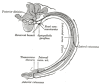
A transverse slice through the thoracic region is shown in the flick. The rami communicantes are labeled and drawn as two nerves that anteriorly bridge the spinal nerve onto a ganglion of the sympathetic trunk. The white ramus communicans is the lateral (more...)
Effigy
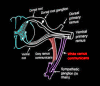
White rami communicans. Epitome courtesy S Bhimji Dr.
References
- 1.
-
Nodera M, Oikawa M, Nakazato Grand, Ishida T, Takeishi Y. Sympathetic nervous remodeling is induced in the intermediolateral nucleus afterwards myocardial infarction - Office of BDNF-TrkB axis. Neurosci Lett. 2018 Oct 15;685:114-123. [PubMed: 30121216]
- 2.
-
Waxenbaum JA, Reddy V, Varacallo M. StatPearls [Cyberspace]. StatPearls Publishing; Treasure Island (FL): Jul 29, 2021. Beefcake, Autonomic Nervous System. [PubMed: 30969667]
- three.
-
Ernsberger U, Rohrer H. Sympathetic tales: subdivisons of the autonomic nervous system and the impact of developmental studies. Neural Dev. 2018 Sep thirteen;xiii(1):20. [PMC free article: PMC6137933] [PubMed: 30213267]
- 4.
-
Kaiser JT, Lugo-Pico JG. StatPearls [Internet]. StatPearls Publishing; Treasure Island (FL): Jul 31, 2021. Neuroanatomy, Spinal Nerves. [PubMed: 31194375]
- 5.
-
Immature HM, Cane KN, Anderson CR. Development of the autonomic nervous system: a comparative view. Auton Neurosci. 2011 Nov xvi;165(1):ten-27. [PubMed: 20346736]
- 6.
-
Jetti R, Kadiyala B, Bolla SR. StatPearls [Cyberspace]. StatPearls Publishing; Treasure Island (FL): Aug xi, 2021. Anatomy, Dorsum, Lumbar Sympathetic Chain. [PubMed: 30969736]
- 7.
-
Cho HM, Lee DY, Sung SW. Anatomical variations of rami communicantes in the upper thoracic sympathetic body. Eur J Cardiothorac Surg. 2005 Feb;27(two):320-4. [PubMed: 15691689]
- viii.
-
Misiak P, Jabłoński S, Rzepkowska-Misiak B, Piskorz 50, Brocki K, Wcisło S, Smigielski J, Kordiak J. Evaluation of the effectiveness of thoracic sympathectomy in the treatment of chief hyperhidrosis of hands and armpits using the measurement of skin resistance. Wideochir Inne Tech Maloinwazyjne. 2012 Aug;vii(iii):147-55. [PMC costless article: PMC3516992] [PubMed: 23256019]
- nine.
-
Akil A, Semik Thousand, Fischer South. Efficacy of Miniuniportal Video-Assisted Thoracoscopic Selective Sympathectomy (Ramicotomy) for the Treatment of Severe Palmar and Axillar Hyperhidrosis. Thorac Cardiovasc Surg. 2019 Aug;67(5):415-419. [PubMed: 29739022]
- 10.
-
Kim DY, Paik HC, Lee DY. Comparative assay of T2 selective sectionalisation of rami-communicantes (ramicotomy) with T2 sympathetic clipping in the handling of craniofacial hyperhidrosis. Eur J Cardiothorac Surg. 2004 Aug;26(2):396-400. [PubMed: 15296904]
- 11.
-
Lee DY, Kim DH, Paik HC. Selective division of T3 rami communicantes (T3 ramicotomy) in the treatment of palmar hyperhidrosis. Ann Thorac Surg. 2004 Sep;78(3):1052-v. [PubMed: 15337046]
Source: https://www.ncbi.nlm.nih.gov/books/NBK549910/
0 Response to "Sympathetic and Parasympathetic Gray and White Rams Review Pdf"
Post a Comment